
©2021 Deborah Richardson





Privacy Policy
Copyright



Turvey Society
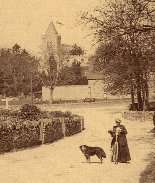
Turvey has always been a sociable village, with many clubs and societies for its residents. On these pages we explore those organizations and other aspects of village life. You can use the buttons on the left to go to pages dedicated to various aspects of village life.
 Schools
Railways
World Wars
Church Choir
Special Occasions
Schools
Railways
World Wars
Church Choir
Special Occasions
Many of Turvey’s clubs and societies were founded by Charles Longuet Higgins.
Brownies and Scouts
The first Turvey Brownie pack was started in the early 1960's by Ethel Umney. In the following years the church organist, Enid Wandsworth became the Brown Owl with Gwen Wooding as her Tawney.
There was also a Scout pack which from 1928-
According to Quarter Session records, in 1843, Turvey petitioned that the police force should be discontinued except for the chief constable and superintendents!
Turvey Cricket Club
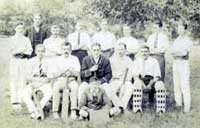
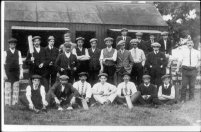
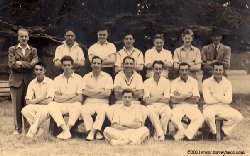
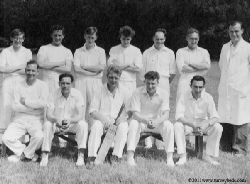
Here are some old photos of Turvey's cricket team. This was a noted county club in the 1890's. At this time the captain was George Edward Hopkins -
The top right picture is from 1949. Sadly I do not know the date of the others. If you click the two right hand pictures, they will enlarge so you can see more details.
Turvey had its own policemen. A visitor to this site remembers PC Lake and PC Pickering.
Dear Gert
Just found out that I can’t com out today Missus just tolded me because she is going out to tea I think she might have said so before I don’t know wether you will get this be 4 oclock but I hope so She did not tell me while 11:15 this morning
Goodbye Best love
Boss
Picture postcard sent from Turvey to Miss G Roberts of 45 DeParys Avenue, Bedford, dated 1.05 pm, February 13th 1906. Please note that the spellings are as the original.
Villagers had their own ways of saying things.
Postal Services in Turvey
With many postal deliveries throughout the day, people could once send postcards where we would now use a telephone. I know that one could certainly not post a postcard in the middle of the day in Turvey now and expect anyone in Bedford to receive it before 4pm! There is now only one post a day.
Turvey had a branch of the Bedford District of the Independent Order of Odd Fellows.
It was called Victoria Lodge and was formed in 1842. Between 1926 and 1932, members could receive a payment of 2/ per week if they were unable to work because of sickness.

Turvey Friendly Society
The Friendly Society was formed to help villagers with burial expenses and when wage-
Turvey Horticultural Society
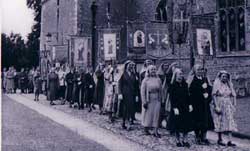
The Turvey Horticultural Society began its Annual Flower Show in 1875. Competition was tough and a large proportion of the village would turn out to see the exhibits.
Here are the Committee members as of Monday 18 August, 1879.
Turvey Temperance Society
Turvey had a busy Temperance Society -
Senior Branch -
The secretary was E Harley
Junior Branch -
The secretary was M E Foskett
T.A.T.S.
More recently Turvey has had a particularly good theatre group -
They were founded in 1980 and have done some excellent productions (I know this,from personal experience!)
To find out more about their latest productions, why not visit their website -
Nuns march from the Parish Church carrying embroidered banners from various local church groups.


Turvey Football Team
Turvey played in the Bedford and District Football League for many years.
In 1938-
The club strip was “Green with White Cuffs & Collars, White Knicks”.
The Club Secretary was F.I. Horn of 6 May Road, and their “dressing room” was Bailey’s Cafe in Bridge Street.
They played the following fixtures for that season. H= home, A=away
3/9 -
10/9 -
17/9 -
24/9 -
8/10 -
15/10 -
29/10 -
5/11 -
19/11 -
26/11 -
3/12 -
10/12 -
17/12 -
24/12 -
26/12 -
7/1 -
14/1 -
21/1 -
28/1 -
4/2 -
11 /2 -
25/2 -
4/3 -
11/3 -
18/3 -
25/3 -
1 /4 -
8/4 -
22/4 -
6/5 -

The Turvey Web Site -
This website and its content is copyright of Deborah Richardson -
Any redistribution or reproduction of part or all of the contents in any form is prohibited other than the following:
You may print or download to a local hard disk extracts for your personal and non-
You may copy the content to individual third parties for their personal use, but only if you acknowledge the website as the source of the material
You may not, except with our express written permission, distribute or commercially exploit the content. Nor may you transmit it or store it in any other website or other form of electronic retrieval system.